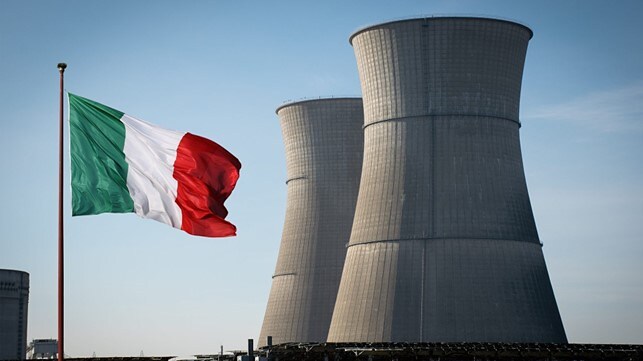
On 4 June 2026, Italy’s Chamber of Deputies granted its first-reading approval to a major framework bill on “sustainable nuclear energy”, signalling a turn in a very long-standing energy debate in Italy. The vote record – 155 for, 86 against and 8 abstentions – does not reopen nuclear power generation in Italy for now, but it does set in motion a regulatory process that might lead to its re-introduction during the first half of the next decade. The text now moves to the Senate for a second reading to complete its parliamentary path. It was the Ministry of Environment and Energy Security (MASE), headed by Gilberto Pichetto Fratin, that pushed the project, but the government viewed the initiative as a component of a larger plan to equip the country with energy sovereignty, give spot to stable prices, and speed up the reduction of greenhouse gases.
The major issue behind is the growing challenge of ensuring a constant and affordable supply of electricity only through renewables and imported fossil fuels, in times of high geopolitical tensions and increase in electricity demand. This reform is, politically speaking, the strategic idea of Prime Minister Giorgia Meloni who has always voiced the problem of Italy’s energy dependency from other countries and the need to strengthen national resilience. Nuclear energy is now brought back into the national energy policy discussion after a long period of political contention.
The message from the government is clear: renewables can, and should, stay at the forefront of the energy transition, but since they are not capable of being switched on or off on demand there is a need to supply them with stable and low-carbon baseload capacity. That is how nuclear energy has got into the picture as a part of the “new energy mix”, which together is able to make sure that the energy supply is interrupted as little as possible and that the system is stable even when the whole economy is running on electricity.
A major component of the legislative strategy is the explicit break with Italy’s nuclear past. The new system does not include reviving reactors that have been shut down, all of which are planned for decommissioning or conversion, in line with Italy’s nuclear phase-out programme. It is first and foremost aimed at advanced technology solutions, mainly Small Modular Reactors (SMRs) and Advanced Modular Reactors (AMRs), which are different from existing large reactors: they are safer, built in modules, and possibly with quicker installation times. In fact, the policy decision was not to go back to old nuclear facilities. Rather, it was an overt move towards Generation III and Generation IV systems, with particular emphasis on modular designs.
SMRs are typically recognized as nuclear power units with a power output much lower than that of traditional large plants and they are capable of being mass-produced under factory conditions and then moved to a site for assembly. The International Atomic Energy Agency (IAEA) describes SMRs as reactors which “provide better safety, less initial capital investment, and increased deployment flexibility when compared to conventional nuclear power plants”. The main idea in the nuclear industry here is standardisation: through the production of identical modules, the developers aim to minimize long-standing issues in the nuclear industry such as construction risks, cost overruns, and project delays. AMRs are just another step in technological advancement, designed to be more efficient by employing different kinds of coolants, like molten salts, gases, or liquid metals, and they also target the enhancement of fuel efficiency, minimisation of waste, and safety features by nature. In addition, AMRs function at atmospheric pressure or even using passive safety systems that depend on physical principles rather than mechanical interventions, which means that the likelihood of severe accident situations is low.
From the point of view of a policy-making and industrial focus, the clear distinction between traditional nuclear plants and modular systems lies not just in the size but also in the structure. Typical large-scale reactors are characterised by long construction periods, high initial investments, and custom engineering. However, SMRs and AMRs are engineered for repetitive manufacturing patterns, quick construction, and gradual power capacity mobilisation.
Such a change in technology is the main focus of Italy’s lawmaking, which openly wants to prevent the reopening of the old ways of infrastructure. Rather, it puts the country on the same path as other nations where nuclear energy is being seen as a modular and scalable part of low-carbon energy systems rather than a monolithic baseload technology.
This change is becoming quite significant within the European scene. In fact, the European Commission’s Joint Research Centre located small modular reactors among the nuclear options that can help the EU to achieve its carbon emission reductions, mainly when it comes to maintaining stable electricity supply in the scenarios with a large share of renewables.
Rather than standing out as an isolated national exception, Italy’s strategic positioning turns out to be part of the gradual redefinition of the nuclear energy discourse at the European level. This change, politically speaking, has major consequences: reflecting the attention on SMRs and AMRs, the Italian system clearly shows the nuclear issue as something that can fit with a system where renewable energy dominates rather than as something to replace it with.
The bill authorizes the government to set in motion a comprehensive set of implementing regulations within 12 months. These will cover the entire nuclear value chain, from production and nuclear fuel cycle management through disposal of radioactive waste and decommissioning of existing nuclear facilities. Another change is the provision for a mechanism whereby municipalities may decide to propose to host nuclear installations, which is a tool aiming to improve territorial governance and reduce local resistance. On the timing side, the government has signalled that the regulatory system could be ready by the end of 2026 and pilot project authorizations might be given towards the end of the decade. The first production of electricity could occur in the early 2030s. This timeline takes into account both the construction of nuclear infrastructure and the desire to synchronize the deployment with the completion of technology training.
The Italian plan should also be understood as part of a wider European movement, going beyond the national level. Nuclear energy has slowly come back to the heart of EU energy policy recently. Italy’s path mirrors joining as a full member of the European Nuclear Alliance initiated by France under President Emmanuel Macron. In this changing European context, nuclear is not considered anymore as a marginalised technology and more as a tool for ensuring the stability of the energy system during the net-zero transition.
Meanwhile, the European debate continues to be quite fragmented. Different Member States have different regulatory traditions and they also have different political concerns when it comes to nuclear power. In such a context, the decision of Italy to reinstate nuclear energy does not signify that all of Europe is moving in the same direction, rather it is a sign that some countries are gradually getting together in their efforts to find a way for decarbonisation targets and energy independence to co-exist. Such contradictions resulted in a rather divisive parliamentary debate in the Italian Parliament. The governing majority supported the proposal while the opposition parties mostly disapproved of it on the grounds of environmental, safety and governance issues. The latter also reminded that the legacy of the 1987 referendum remains unresolved. Though, the passing of the enabling law clearly communicates a new willingness on the part of politicians to reconsider a strategic element on the energy policy that had been kept out for nearly forty years.
The main point from a policy point of view is that this moment should not be seen as a time when an industrial programme starts immediately but rather as a time when the construction of an institutional structure is taking place. The actual challenge will be found in the implementation phase: the ability to regulate, the technological validation, the processes for selecting the sites, and the most important, the ability to keep political and social consensus for a long time.
That is why Italy’s nuclear return should be seen as a move to keep one’s options open for the broader European energy transition. It involves realising that it is hardly possible that decarbonisation paths will be straightforward and that energy systems of the future will need a diversified set of technologies that can ensure resilience, affordability and security at the same time.
A number of elements that go beyond legislation will determine if and when such a strategic option will result in an operational capacity. Nuclear energy has come back onto the policy radar of both Italy and Europe not as an old debate but as a part of industrial and geopolitical strategy looking into the future.
Sources
- Corriere della Sera. Nuclear in Italy: First Parliamentary Vote on the Nuclear Framework
Law After the Failure of Berlusconi’s Plan (4 June 2026). - European Commission. Nuclear Energy Policy in the European Union: Policy Framework
and Strategic Overview. - European Commission, Joint Research Centre, Small Modular Reactors in Europe.
- International Atomic Energy Agency (IAEA). Small Modular Reactors: A Guidebook.
- International Atomic Energy Agency (IAEA). Small Modular Reactors (SMRs): Overview,
Definitions and Key Characteristics. - Italian Parliament, Chamber of Deputies. Framework Law Delegating the Government on
Sustainable Nuclear Energy (A.C. 2669). - OECD Nuclear Energy Agency (OECD-NEA). Advanced Nuclear Reactor Systems and
Future Energy Market Needs.