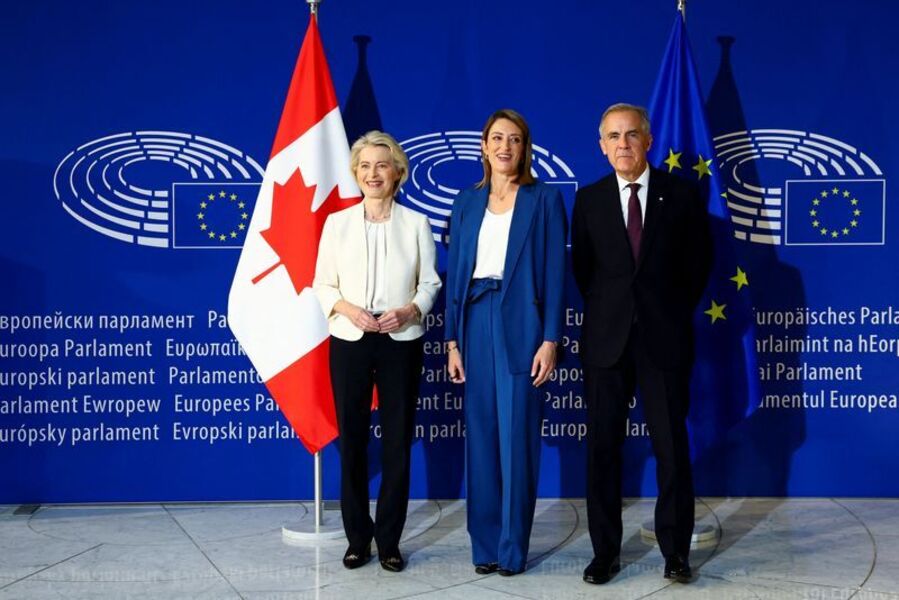
From CETA to an “Alliance for the Future”
By offering Canada the opportunity to join as the European Union’s first “associate member” during her 2026 State of the Union address, Ursula von der Leyen was doing more than proposing a new form of alliance. She was signalling that the EU may be entering a new phase in the way it manages its external economic and geopolitical relationships.
The proposal is still in its infancy. There is as yet no defined status of “associate membership” in the EU, nor have the corresponding rights, obligations and institutional arrangements been established. Though, that should not mask the political nature of the effort. Von der Leyen announced the proposal as an “Alliance for the future”, including defence, critical minerals, energy, artificial intelligence, quantum technology, cyber security and economic security.
Canadian Prime Minister Mark Carney’s address the next day revealed Ottawa’s strategic calculation was something similar. Speaking to the European Parliament, Carney said that Canada and Europe must seek to deepen their relationship using what he called “collective resilience”. The idea is that neither Canada nor Europe need to do it alone, but both should reduce their vulnerability from over-dependence on external actors.
This marks a key development in the relationship. For years the relationship between Canada and the EU was defined almost solely on trade through CETA, but nowadays the relationship is defined by a much wider web of collaboration. Canada is now involved in Horizon Europe, the EU and Canada have established a Security and Defence Partnership, cooperation over critical minerals has grown, and Canada is now the first non-European country to join the EU’s SAFE defence procurement system.
Greater significance should be attached to the system behind the associate regime. The design might have a real effect on the EU’s external relations, provided it remains a mechanism that helps close cooperation across strategic sectors.
The novel arrangement would fall somewhere between a classic free-trade agreement and full-blown political integration. Canada would not be an EU member country, and there is no sign that this is the aim. Rather, the partners might aim at a unique form of cooperation whereby Canada takes full part in certain European programs, markets, purchasing procedures and strategic initiatives.
That possibility is important precisely because it signifies a broader shift in the international sphere. Commerce, technology, energy, and security are becoming even more intertwined. Access to critical minerals affects industrial policy; industrial capacity affects defence capabilities; digital infrastructure affects national security; and technological standards are becoming increasingly geopolitical.
The Canada-EU relationship is testing the limits of whether Europe can forge a more adaptable form of strategic integration with trusted partners outside the Union.
Strategic complementarity: resources, technology and industrial capacity The economic argument for a strengthened relation starts from the complementarity between the two sides.
Europe offers market scale, advanced manufacturing capabilities, research networks, regulatory influence and significant investment capacity. Canada has energy, raw materials, tech know-how, institutional capital and a special Arctic and North Atlantic geographical position. Both are G7 economies, NATO allies and long-standing democracies with broadly synergetic institutional
foundations. The strategic importance of this relationship rests less in the opportunity to expand bilateral trade as such, and more in creating links between complementary capabilities.
This is particularly true of critical minerals. Europe’s industrial transition is becoming more reliant on secure access to lithium, nickel cobalt, graphite, rare earth elements and other raw materials required for batteries, electric vehicles, renewable energy installations, electronics and military equipment. Meanwhile, global supply chains for some of these resources are still heavily reliant on just a few countries.
Canada could make an important contribution to the diversification of European industry. A relationship on a deeper level could bring European investment into Canadian extraction and processing operations and link that process with European manufacturing and technology.
This kind of approach would change the relationship from a traditional buyer-supplier to a fully integrated industrial partnership. For Europe, this could improve security of supply. Canada could use European capital and industrial demand to foster the emergence of a domestic value chain.
The same principle applies with energy.
Europe has taken measures recently to diversify energy sources and shield itself from geopolitical shocks. Canada has natural resources, as well as an Atlantic geography to support higher volumes of energy export to Europe. These areas could support cooperation. The objective must not be read as replacing one external dependency by another. What makes this a worthwhile strategic effort is that it expands the number of safe options for European governments and companies.
This is the practical meaning of diversification.
Another aspect of this relationship is also given by defence. Canada’s participation in SAFE is significant because it translates political alignment into a concrete form of industrial cooperation. In fact, Canadian companies could compete in EU defence procurement, this way offering the possibility of industrial cooperation and crossborder integration.
The significance of this development is not limited to conventional weaponry. European defence policy is becoming more and more indistinguishable from industrial policy and technological policy. AI, cyber security satellites, advanced materials and secure communications are defence capabilities and commercial technologies at the same time.
Enhanced linkages between Canada and the EU could lead to cooperation across a wider technology ecosystem, such as research investment procurement and industrial partnerships.
The same is valid for artificial intelligence, quantum technologies and space. Canada has developed considerable research capacity in these fields, and Europe offers a large market, high existing
research capacity and an increasingly important policy and regulation structure. In addition, Canada’s engagement in Horizon Europe creates the institutional basis for a broader scientific cooperation. The challenge now is to integrate research activities more closely with investment, commercialisation and strategic procurement. The technological competitiveness is more and more an ecosystem at the world stage than a single enterprise.
Canada and Europe will not, by themselves, be able to emulate the size of the US’s technology ecosystem. Though, they can add together strategic strengths among them and attain further scale.
Finally, let’s not forget the important part related to the Arctic.
As a very geostrategically situated country, Canada represents a significant actor in an area where security, shipping, energy, critical minerals and infrastructure are becoming interlinked. Von der Leyen has also pointed out the Arctic as a single space where Canada and Europe could have flagship cooperation. A more integrated Europe and Canada would give access to a geographical and strategic potential that no single European state is able to replicate. For Canada, the European presence and know-how would be a potential for the development of the north’s infrastructure and economy. The Arctic this way further supports this notion that the EU-Canada relationship can not only be described as a trade relationship. Its strategic proposition is growingly interrelated with economic, technological and security interests.
The Trump factor and the logic of strategic diversification
The American dimension is absolutely unavoidable.
The interdependence of the Canadian economy with that of the US is relevant and the relationship continues to be of critical importance. Their closeness geographically, the integrated supply chains, and the size of the US market, make an entire economic shift toward Europe unlikely.
The strategic question is not whether Canada can replace the United States with Europe.
The ultimate question is whether Canada will be able to lessen the reliance of its economic security on the political choices made by one partner.
The policies of Donald Trump have brought this matter to the forefront. The employment of tariffs and the general uncertainty when it comes to United States trade policy have prompted Canada to look elsewhere for investment and trade opportunities. Trump’s response to the EU-Canada proposal confirms this: Washington is already paying some attention to the prospect of an extended economic alliance between Ottawa and Brussels. The US president has challenged the plan and threatened punitive trade measures. But, it would be too easy to regard the Canada-EU project as an anti-Trump one.
The rationale is broader. Canada had, and still has, strong economic incentives to develop diverse trade relationships. Europe, faced with a monopoly over supplies of certain important raw materials, such as natural gas, has similar aspirations.
In this sense, we shall regard this alliance as a strategic insurance. Canada cannot play the US to Europe, nor can Europe play the US to Canada. But neither side needs to replace Washington to make itself less vulnerable. This could also be the case that the initiative will, in the end, have a reinforcing effect rather than a distorting one on the general transatlantic system. A more robust web of ties does not necessarily mean a weaker alliance. The idea behind is not so to create an alternative geopolitical but to develop a more diversified transatlantic network.
From political announcement to institutional architecture
Perhaps the most challenging aspect of the initiative will actually be institutional rather than geopolitical. The status of “associate membership” is now a political one, not an existing legal status under the EU Treaties. The current association agreements are a source of existing precedents for possible arrangements of co-operation with non-Member states, but they are not a given “ready-made” model for what Canada is now being offered. The content of the proposal should be of far greater importance than its title.
Ultimately both parties will have to decide what the deal should offer in return for enhanced cooperation. Expanded market access for Canadian companies into Europe? Access for Canada to more EU programmes? New arrangements in the areas of research, digital trade, financial services or mobility? Alignment with certain EU regulatory regimes? Financial contributions?
Any of these questions could be a discussion on its own. Institutional arrangement will also influence the appeal of the deal for member states. Governments will likely analyze whether a more integrated Canada provided a strategic advantage or precedent which might act as a future obstacle to the EU broader external policy. This is where the initiative moves from being a matter of geopolitics to becoming a matter of public policy. While the European Commission could supply the political momentum and bargaining power, the shape of the final relationship will be determined by the political will of member states and European institutions to take on the rights and obligations of a new relationship.
This institutional aspect is even more crucial when it concerns the business sector. Political statements might raise expectations but it is only a tangible setup that brings predictable access to the market, the creation of opportunities for investment, and the stability of the rules.
A new model of strategic interdependence
The overarching significance of the initiative may in fact have far reaching implications beyond Canada. If Brussels manages to build a convincing model of deep strategic integration with a third country which is not part of the EU, other close partners will want to have a look at it. Countries closely linked to Europe economically and politically may wonder if such an architecture could facilitate access to the European Union’s markets, programmes and strategic initiatives.
Canada is aligned politically with Europe, is a member of the G7 and NATO, has significant natural resources and technological potential, and enjoys a strategic position. The political story is clear already: Europe needs resilient supply-chains and Canada needs diversified markets; both need stronger industrial and technological bases; both benefit from a common approach to stable rules for international trade and investment.
The measure of the relationship will be in investment flows, industrial projects, defense procurement, research cooperation, energy infrastructure, supply chains in critical-minerals and companies’ ability to operate more seamlessly across the Atlantic.
This explains why the next phase will be so important for policymakers, investors, and public-affairs professionals. The Canada-EU relations are growing as a policy issue that crosses different ministerial domains. Trade policy is increasingly connected to industrial policy; industrial policy is connected to defence; technology is linked to economic security; and Arctic policy increasingly intersects with all of these areas.
What at first glance seems to be a diplomatic effort could mean a much wider regulatory and economic agenda. The economic argument for more cooperation rests upon a more straightforward principle: options lead to resilience.
CETA was envisioned to facilitate trade. The nascent alliance could be as much about something much wider: establishing the institutional structure to allow Canada and Europe to co-invest, share access to vital resources, develop strategic technologies and diversify their economic dependencies.
The policies implemented by Trump have made clear the logic behind this diversification, but its structural drivers are various, at the geopolitical level; at the supply-chain level; and at the level of technological competitiveness.
The issue is whether Canada and Europe can convert a crowded network of agreements and alliances that now exists into a new architecture of strategic interdependence, an architecture not built to close US doors but rather to provide greater resilience to US openness. In the best case scenario, if they succeed, what was announced by von der Leyen may not just turn out to be a new
chapter in EU-Canada relations, but also a precedent for the way Europe forges strategic partnerships in an era of shrinking borderlines between trade security technology and geopolitics.
Sources
– European Commission, 2026 State of the Union Address – Ursula von der Leyen, 16 September 2026. European Commission
– Government of Canada, Prime Minister Carney delivers an address to the European Parliament, 17 September 2026. Government of Canada
– Council of the EU, SAFE: Council concludes agreement with Canada, 15 June 2026. Council of the EU
– Reuters, EU chief wants Canada to become an “associate member”. What does that mean?, 16 September 2026. Reuters
– European Commission, Midday Press Briefing, 18 September 2026. European Commission Audiovisual Service
– Government of Canada, Prime Minister Carney to strengthen Canada’s ties with European partners, 12 September 2026. Government of Canada